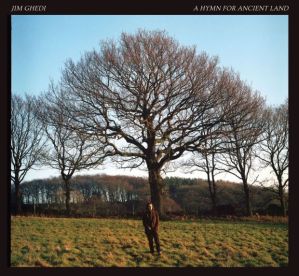
 There are records that sing of the land, and those that wear traces of its soil beneath its author’s fingertips. Nature is a coarse thing, roughly marked by men and women who have known the abrasion of bark and nettle, skinned knees and chapped lips, seasons marked by sloe berries and the quick snap of frost. “In north-east Derbyshire,” Jim Ghedi begins at last, “I have worked my years.” Five songs in, they’re the first words spoken on A Hymn for Ancient Land, and the preceding tracks immediately feel less like instrumentals and more like their own wordless storytelling, the landscape rendered in strings and bows before anything as brittle as language is permitted to enter the fray.
Continue reading at God Is In The TV
 When I talk about voices, I am gesturing around the room. It is understood that voices are non-white, female, queer, working class, trans, excluded or otherwise compromised narratives that require underlining in urgent reds and blacks.
 Regardless of whether anyone needed to hear this record, certainly no one needed to make it. It was famously documented in 2003 that, at one point, 43 percent of songs on U.S. radio (and 20 percent in the UK) were Neptunes-produced; the team of Pharrell Williams and Hugo Chavez were having to stagger releases, essentially to stop all their own songs competing against each other in the charts. With a hit-making machine already in place, the addition of Shae Haley to establish N.E.R.D. allowed Pharrell a playground for his more audacious off-cuts. On NO_ONE EVER REALLY DIES, their first output since 2010’s wildly inessential Nothing, the trio’s meandering avant-rap is somehow more encumbered by its lack of ideas than its lack of editorial savvy.
 The capitulations of the body form the basis for every Baths record, a foreign field eternally compromised by grand massacres and little deaths. At the time of Will Wiesenfeld’s last outing, the dark heaven that was 2013’s Obsidian, his body had just begun to recover from its loudest rejection yet: a fierce bout of E. coli that left the artist barely able to eat or sleep for any length of time. That album, like Sufjan Stevens’ Age of Adz three years prior, was less a joyous celebration of new health than a post-mortem at the body’s point of failure. This was billed in interviews as Baths’ “weird version of a pop record” at the time which, even as a qualifying statement, may have been a stretch; its most urgent highlight (‘No Eyes’) found the artist pleading to be fucked, with or without sincerity. On Romaplasm, Wiesenfeld seems to have finally made something that could pass as a pop record, exuberant in both its content and execution.
 From start to finish, the intersections of love and death that played out across the record (see: auto-erotic asphyxiation tribute “Die 4 You”) never felt cheapened by the gauzy nightdress they came swaddled in, but elevated by its vaudeville sexuality.
 Perhaps I’m reading too much into it – as writers, it is our job to stretch cogent narratives across increasingly cracked and disparate landscapes – but my top ten feels subdued this year. For the most part, these are albums defined by their restorative properties, where global anxieties are conveyed through sighs and whispers rather than shouts. It won’t stay that way for long.

 Like magical realism, the key signifiers of ambience are invariably opaque: as a genre, it thrives on ambiguity, haze, distortion, the ‘undecidable’, the inversion of assumed values. Light, where permitted, may only be dusky or twilit, carved out in anaemic shards of an otherwise pitch-black or cobalt totality. It may not be bright or, heaven forbid, sunny. It should not conjure Miami or California. Beyond all else, the ambient record denotes the absence of certainty, a precious world outside our own built from spiderwebs and choral loops. With L’Orange, L’Orange, Gregg Kowalsky compromises all our prose about misty forests and abandoned skyscrapers. It is incandescent.

