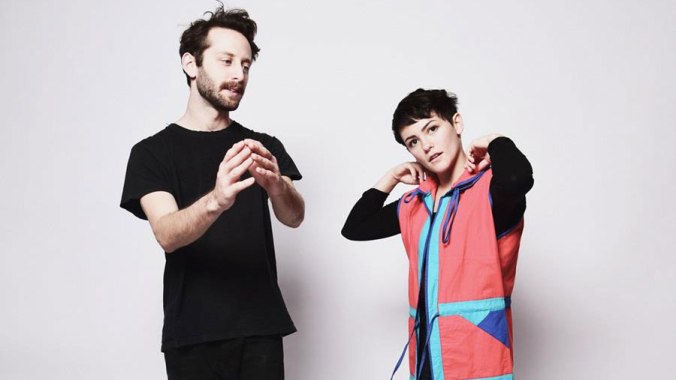
Earlier in the year, Nika Roza Danilova was working on a new piece of music while a thunderstorm raged outside. The artist, who has just released her fifth album as Zola Jesus, has often been described in terms more befitting a mage or sorcerer: critics talk of her exorcising demons, casting spells, illuminating the nighttime that her songs invariably arrive cloaked in. On that night, it appears she channelled the elements in a more literal fashion.
“I don’t know, maybe you know more about physics and electricity than me,” she offers, incorrectly. “But I was in my house, and it was storming, thundering, lightning outside, and I was working on this piece. So I leaned over and I touched my desk, and all of a sudden my whole body got this jolt of electricity. It didn’t even just course through me, it was like my brain got shocked.” After the year she’s had, and the fulminating qualities of new record ‘Okovi’, it feels like a prescient moment.
Continue reading at Clash
 Mistress of the labyrinth, bride of Dionysus, goddess of mazes, paths, snakes, fertility, passion and wine, the legend of Ariadne is built on the twin pillars of ecstasy and uncertainty. Kedr Livanskiy, the musical alias of Moscow-based singer and producer Yana Kedrina, treads a similar path: her debut ‘Ariadna’ carries a thread that runs from the Romantic poets of the 1790s to the nascent electronic scene of 1990s Russia. Much like the Greek heroine, Kedrina’s ability to incorporate these strands into her music doesn’t prevent her from occasionally losing the way.
 Nadine Shah is texting me from a Wetherspoons. ‘I’m gonna duck out of this shithole and call you in 6mins. That ok?’ Half an hour later, we’re wrapping up with a discussion of their gin palace. (She’s got a double waiting inside.) Somewhere in between, we cover the Syrian refugee crisis, British nationalism, the current Tory government, immigration, gender, and revolution.
 The vocabulary of post-punk is one that shifts, but never bends. Its album reviews – certainly this side of ‘Silent Alarm’ – are littered with the kind of abrasive descriptors that suggest the album may also function as a rudimentary bandsaw: jagged, angular, serrated, combined with a mitre fence for accurate repetitive cuts. Thank heavens for Mammút then, whose fourth album ‘Kinder Versions’ is equally arch at its edges and swollen with unkempt joy in the middle.